Billy Crystal was just getting heat as a comedian when he was offered the part of Jodie, a gay character in a new ABC comedy. It was 1976, and the idea of playing gay in primetime was unorthodox and unsettling. But the show — Soap — came with a pedigree. Director Jay Sandrich — who had shepherded such hits as The Mary Tyler Moore Show, The Odd Couple and The Bob Newhart Show, was attached. So Crystal asked to meet with the show’s creator, Susan Harris.
“I was expecting your typical comedy writer,” Crystal says, “a woman who looked like a man, who chain-smoked and had a half-eaten corned beef sandwich in front of her. But in walked this beautiful woman with this huge mane of hair.” Without fanfare, Harris outlined her vision for the show and for his character. “She convinced me that we had the chance to do something different. After that meeting I thought, ‘I’m going to do this.’ I trusted her. She was the first genius I had ever met.”
Throughout her career, Harris has offered the unexpected. Certainly, when she broke into the business, she didn’t look like most comedy writers. Almost everyone was male, and here was this tall, lean and elegant woman. But she has never acted like most writers, either. When others were honing their make-’em-howl pitches, Harris decided pitching wasn’t for her.
“Once people knew I could write, the pitching didn’t really matter,” she says. Studio chiefs didn’t agree — the head of Columbia once called her agent, complaining, “She’s a comedy writer and she’s not funny.”
He was right, Harris admits. But it didn’t matter. The characters she went on to create in shows like Soap, Benson, The Golden Girls and Empty Nest leapt off the page as real people who made audiences laugh and cry.
“I had always worked with male writers,” Sandrich says. “But when I worked with Susan, I heard lines from a female writer written for women characters, and they amazed me.” He recalls a scene in Soap, in which a character sees her husband with another woman, then confides in her sister that she felt ashamed and embarrassed. “I thought, ‘What a brilliant piece of writing!’ I, as a man, never would have thought a woman would feel that way.”
Harris’s decision to write was, in part, an act of desperation. Divorced with a two-year-old son, she was looking for work she could do from home. Watching TV one night, she decided that she could write a show as good as what she was seeing. So she and a friend collaborated on a spec script for Then Came Bronson and sold it. From then on, she was on her own, wowing the likes of director Garry Marshall.
“I had never written comedy, but Garry suggested that I write some episodes of Love, American Style,” Harris says. “He told the producers that if I didn’t produce something funny, he would rewrite it himself. He didn’t have to do that.”
It was the early 1970s, and Norman Lear soon came calling with a new show, All in the Family, and then its spin-off, Maude, starring Bea Arthur. Harris was writing for both when Lear asked her to tackle abortion in a Maude script. Originally the idea was for Maude’s neighbor, Vivian (Rue McClanahan), to consider an abortion. “I wrote the episode,” Harris says, “but when Norman read it, he said, ‘This is too good for Vivian. We’re going to give it to Maude.’”
The episode aired in November 1972 — a year before Roe v. Wade — and it hit with a wallop. CBS decided to rebroadcast the episode some months later, but Roman Catholic groups, incensed that Maude decides to go through with the abortion, tried to pressure affiliates into canceling the repeat. The show did air, and 65 million tuned in.
It would not be Harris’s only brush with controversy. By this time confident of her abilities and looking for a new project, she was asked to meet with two up-and-coming producers, Paul Junger Witt and Tony Thomas. “It went so badly, I should have been suspicious,” Witt says of the meeting. “We just didn’t hit it off. Susan didn’t have any stories to pitch — she expected us to give her a story to write.”
Thomas recalls: “She told us, ‘I don’t do stories.’ She was pretty cocky.”
The three parted ways, but Witt and Thomas didn’t forget that headstrong scribe. “I had read a script she had written for Maude that was extraordinary,” Witt says. A year later, when he and Thomas set up shop at Danny Thomas Productions, Harris was their first hire. The three began a friendship and a business partnership that continue to this day.
“We hit it off creatively,” Witt says. “We spoke the same language. It was an extraordinary coming together of people who saw comedy the same way.”
For Witt and Harris, who married in 1983, it was also a romance, albeit a rocky one at first. “There were times when we were an item,” Harris says, “and times when we only worked together and never spoke outside work.”
“It was a level of personal involvement that at times was awkward,” Witt admits, “especially for Tony, who was like a child in a marriage where the parents were not getting along.”
But the trio — who went on to create Witt/Thomas/Harris Productions — look back fondly on those “kitchen table” years, when they would sit around Harris’s place at night while her son was sleeping, creating characters and stories and making one another laugh. “Those were some of the best times of my life,” Thomas says.
It was around that table that Soap came into being. The wacky melodrama touched plenty of hot buttons, from homosexuality to infidelity, demonic possession and transgender surgery. Religious groups were up in arms. “All of the religions banded together against one enemy,” Witt says. “They hated the show before they saw one frame.”
For her part, Harris was hard at work, writing every episode for much of the first two seasons. Soap lasted for four seasons and spun off Benson, starring Robert Guillaume, but the religious protests dampened ad sales. “The network was very brave to keep it on as long as they did,” Witt says.
But that didn’t diminish their enthusiasm for comedies that pushed the envelope. Harris created It Takes Two and Empty Nest, both shows about the trials of parenthood. Witt/Thomas/Harris also produced Hail to the Chief, starring Patty Duke as the country’s first woman president.
Then, in 1985, NBC was scouting for a writer to create a show about older women living in Miami. A skit promoting Miami Vice — in which Doris Roberts and Selma Diamond kept calling the show “Miami Nice,” saying it was about seniors in Florida — got executives thinking there might be an audience for this kind of humor.
“I was sitting with another writer when [NBC executive] Warren Littlefield gave us this idea about older women, and this writer said, ‘I don’t write old people,’” Witt recalls. “I said, ‘I know someone who would be interested.’’’
At the time, he and Harris were newly married and she was at home with their baby. But Witt was right — Harris was interested. “When Paul told me ‘older women,’ I was thinking women in their 70s,” Harris says. “I love writing older people because they have stories to tell. Of course, when the network was saying older, they were thinking women in their 40s.”
Harris knocked out the pilot for The Golden Girls, and indeed it was golden.
“I was raised with an entertainer,” says Thomas, son of Danny Thomas. “I would see large rooms full of people burst into laughter at the same time. When we previewed the The Golden Girls for 900 people in New York, I saw these people roaring with laughter. It took me right back to my father’s time.”
Witt sat next to director Bruce Paltrow at the screening. “He leaned over and said, ‘You have a perfect pilot here.’”
The perfect stars, of course, were Rue McClanahan, Betty White, Bea Arthur and Estelle Getty. McClanahan and White played widows Blanche Devereaux and Rose Nylund; Arthur was divorcée Dorothy Zbornak, and Getty was her mother, Sophia.
“Susan was aware of both the sexism and the ageism in the industry,” Witt says. “And she tackled it head-on with this show.”
White recalls her first reaction to the script: “You were always seeing a lot of bad scripts. But when we read this one, we knew we had something that was red hot.”
The show ran for seven seasons and twice won the Primetime Emmy for outstanding comedy series; each of the lead actresses also picked up an Emmy. During the run, Harris was diagnosed with chronic fatigue syndrome, a condition doctors did not understand back in the 1980s.
“I was a runner, I played tennis, I was working very hard,” says Harris, who had to stop all of her activities. But she got little help — or sympathy — from her doctors. “One actually suggested that I change my hair color so I would feel better.” Instead, she wrote a scalding episode of The Golden Girls in which Dorothy is diagnosed with the same condition and faces the same contempt.
Despite her long and successful career, Harris still faces her own demons. “Every time I sit down to write, it’s starting all over again,” she says. “I think to myself, ‘I’ve lost it. I can’t do it.’”
Yet the woman who convinced herself that she could write as well as anyone else, who wheeled a baby stroller into meetings with executives, who refused to pitch — is the same woman who always has found the words and the characters that audiences have come to love.
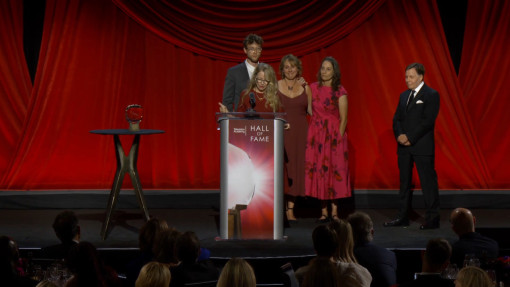
This tribute originally appeared in the Television Academy Hall of Fame program celebrating Susan Harris's induction in 2011.